
Unsafe Water and Unanswered Questions: A Tale of Two Communities
I’ve spent nearly two years working with two communities facing very different contamination issues, yet their experiences with those in charge are disturbingly alike.
First, I've been working with Equity Legal Services and the Community of Cahokia Heights Illinois. I have been advising them on collecting water quality data to measure whether their drinking water meets requirements under the Safe Drinking Water Act. Cahokia Heights has suffered from decades of water infrastructure neglect, including sanitary sewer overflows and unmaintained drainage systems that resulted in significant sewage flooding in residential and industrial areas. Repeat flooding events have rendered many homes uninhabitable, and many have been torn down.
Significant flooding around old, poorly maintained drinking water lines can lead to contaminated water entering the treated water in distribution pipes and being delivered to residents. Further, water mains were designed to serve a larger population that has since declined. As a result, there is excess water in the mains that sits stagnant for longer periods of time. Chlorine dissipates from water that sits in pipes, allowing biofilms to grow and chemical and microbial reactions to degrade water quality.
After years of suspecting drinking water contamination but having their concerns dismissed by Illinois American Water and the Cahokia Heights Water and Sewer Department, residents decided to take matters into their own hands.
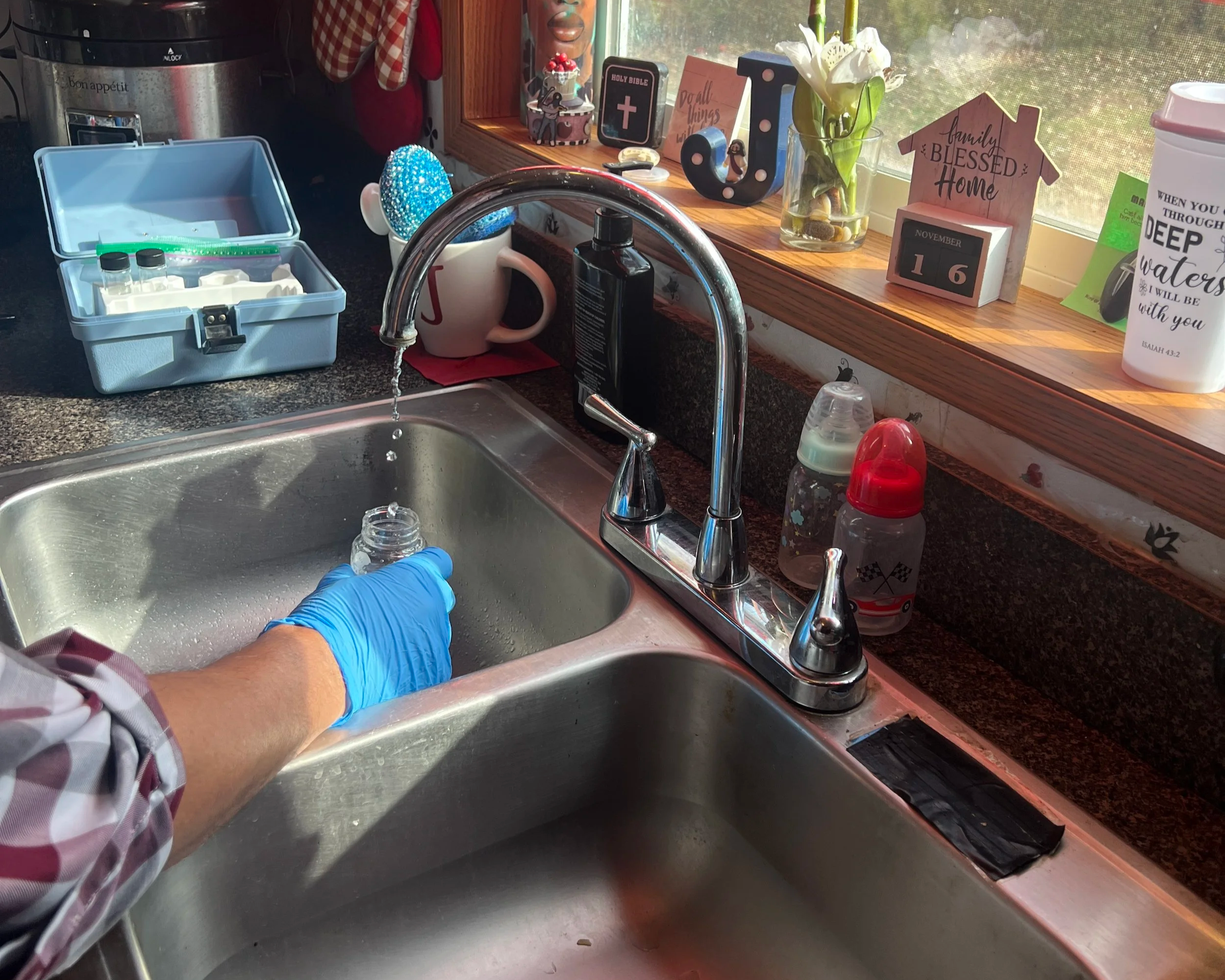
With support from the Joyce Foundation, I was able to assist Equity Legal Services and community members in designing a drinking water sampling study modeled on the Revised Total Coliform Rule. Samples were collected from June to December, 2025. What we found was alarming — in these 7 months of sampling we detected total coliforms (a general indicator of contamination) at 8 different sites and during each of the 7 months. E. coli, an indicator of fecal contamination within the total coliform group, was detected at three sampling sites during four separate months. On top of that, several sites did not meet the Illinois requirement for 1.0 mg/L of total chlorine at every sampling site.
If this dataset had been collected by a regulated water utility it would have triggered a requirement for an investigation by the water utility in July and an investigation by the state in August.
Read here for more information about the community and the sampling program. Check out Equity Legal Services’ website with more community sampling information here.
Next, I’ve been working with residents impacted by the 2021 Red Hill fuel spill that contaminated the Joint Base Pearl Harbor–Hickam (JBPHH) water system and left thousands of Oahu residents with contaminated drinking water. I’ve been working with community members, the Sierra Club, and members of the Red Hill Community Representation Initiative (CRI) to help them understand drinking water monitoring requirements and sampling protocols. I’ve also helped interpret results from the long-term sampling programs implemented by the Navy in response to the contamination. It’s important to note that this is just the most visible of several spills over the past decade.
Although the Navy did acknowledge the 2021 fuel spill contamination, shut down the contaminated sources, took steps to clean the distribution system, and implemented sampling programs, they have been unresponsive to community members’ questions and have ignored real risks to public health. Last week, the Honolulu Star-Advertiser ran an op-ed that I wrote with Susan Gorman Chang, chairperson of the CRI, to bring attention to longer-term issues that are being swept under the rug.
With only one working water source, JBPHH now operates with far less backup than it had before 2021. That puts more strain on the water storage tanks. Tanks balance pressure and provide backup during high water use. Today, the water tanks serve as the system's main safety net, but JBPHH has not met the Navy's own maintenance guidelines for those tanks.
The Camp Smith tanks have not been fully inspected or cleaned since 2013. The Halawa reservoirs have not been inspected or cleaned since 2020, before the 2021 spill. The Environmental Protection Agency's 2024 inspection found sediment at the bottom of every JBPHH water tank they could inspect. Tank sediment can hold contaminants and bacteria for years, even in disinfected water. Industry standards and the Navy itself recommends tank inspection and cleaning every three to five years.
Click here to see the op-ed and our recommendations.
Cahokia Heights and JBPHH residents want the same thing any community wants: a water system that is dependable and provides safe water and the ability to trust those in charge. That starts with rigorous sampling protocols, published water quality data, and real discussion of risks and response.
Keep your eyes on this space to see if these actions trigger real action from Illinois American Water, the Cahokia Heights Water and Sewer Department, the Illinois Environmental Protection Agency, the JBPHH water system, the Navy, and U.S. Environmental Protection Agency.